
What Is NDOC?
NDOC is the official abbreviation for the Nevada Department of Corrections. The abbreviation is confirmed by the Department's own home page, which uses the Nevada Department of Corrections (NDOC) label, and by the public-record fees page, which refers to the Department as NDOC. The agency is the statewide prison operator. It does not run county jail booking desks, city detention rosters, federal custody, ICE detention, or trial-court case files.
The NDOC inmate population is made up of people committed to state prison after sentence, along with people placed in NDOC conservation camps, transitional housing, intake centers, medical and mental-health units, and specialized custody assignments. A person arrested last night in Clark County, Washoe County, Carson City, Lyon County, Nye County, or another locality will usually start in local custody. NDOC becomes the search layer after state-prison commitment or when NDOC data includes the person.
The official NDOC home page is the agency-level source for the Nevada Department of Corrections name, abbreviation, mission, and facility links.
That agency page is the statewide starting point, while the offender search is the direct lookup tool for prison records.
The NDOC Inmate Population
NDOC's December 2025 Monthly In-House Custody Distribution reported 10,587 total in-house offenders on December 31, 2025. The same report series listed 10,537 on December 31, 2024. The year-end change was an increase of 50 people, about 0.5 percent. The research also records earlier points from the same series: 10,181 on December 31, 2023, 10,469 on June 30, 2024, and 10,570 on June 30, 2025.
| Measure | Figure | Source / Year |
|---|---|---|
| NDOC in-house population | 10,587 | Monthly In-House Custody Distribution, Dec. 31, 2025 |
| NDOC in-house population | 10,537 | Monthly In-House Custody Distribution, Dec. 31, 2024 |
| Broader quarterly offender table | 10,922 | NDOC Quarter II FY 2026 statistical summary |
| In-house race/location table | 10,593 | NDOC Quarter II FY 2026 statistical summary |
The NDOC statistics page collects the statistical series behind these prison population figures.
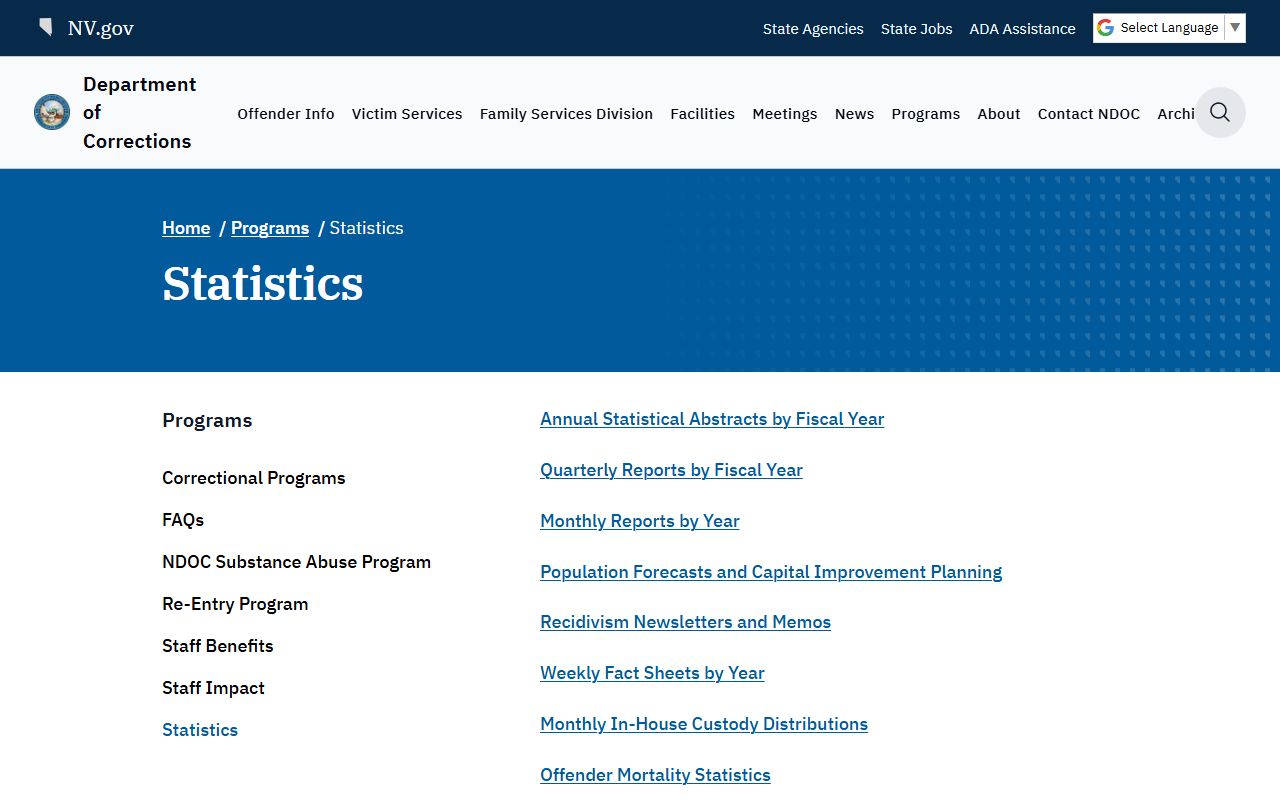
When counts differ across NDOC reports, the safer wording names the report and the slice being counted rather than treating each number as the same population.
NDOC Custody Levels
The December 31, 2025 in-house distribution lists 291 community trustee, 1,135 minimum custody, 6,947 medium custody, 1,791 close custody, 423 maximum custody, and no unassigned offenders. Medium custody was the largest category. Close custody was the next largest. These are custody classifications, not facility names. A prison can hold more than one custody level, and some facilities have intake, regional medical, mental-health, hospice, protected-custody, work crew, or reentry roles.
| Custody Level | Count | Plain-English Meaning |
|---|---|---|
| Community trustee | 291 | Lowest listed custody class, often tied to trusted work or community assignment status |
| Minimum | 1,135 | Lower-security state-prison custody, including camp-style placements where eligible |
| Medium | 6,947 | Main general-population custody class in the December 2025 distribution |
| Close | 1,791 | Higher-control custody for people who need more secure housing or supervision |
| Maximum | 423 | Highest listed custody level in the in-house distribution |
How to Search the NDOC Inmate Locator
The official NDOC offender search is at ofdsearch.doc.nv.gov. The form has two visible search modes. A user can search by Offender ID, which is the most precise route when the ID is known. A user can also search by first name and last name. The form identifies the percent symbol as a wildcard for first or last name, which helps when the spelling, punctuation, suffix, hyphenation, or alias is uncertain.
- Open the NDOC offender search and choose the most precise field available.
- Enter the Offender ID if it is known, since ID search reduces common-name confusion.
- Use first and last name when the ID is unknown, and use the percent wildcard for partial spelling.
- Read the result as raw NDOC data, not as a certified court or law-enforcement record.
- If no result appears, search the county jail roster, BOP, ICE ODLS, S.A.V.E., VINELink, or court records as the facts require.
The NDOC inmate locator displays the search fields, raw-data notice, and downloadable offender data links.
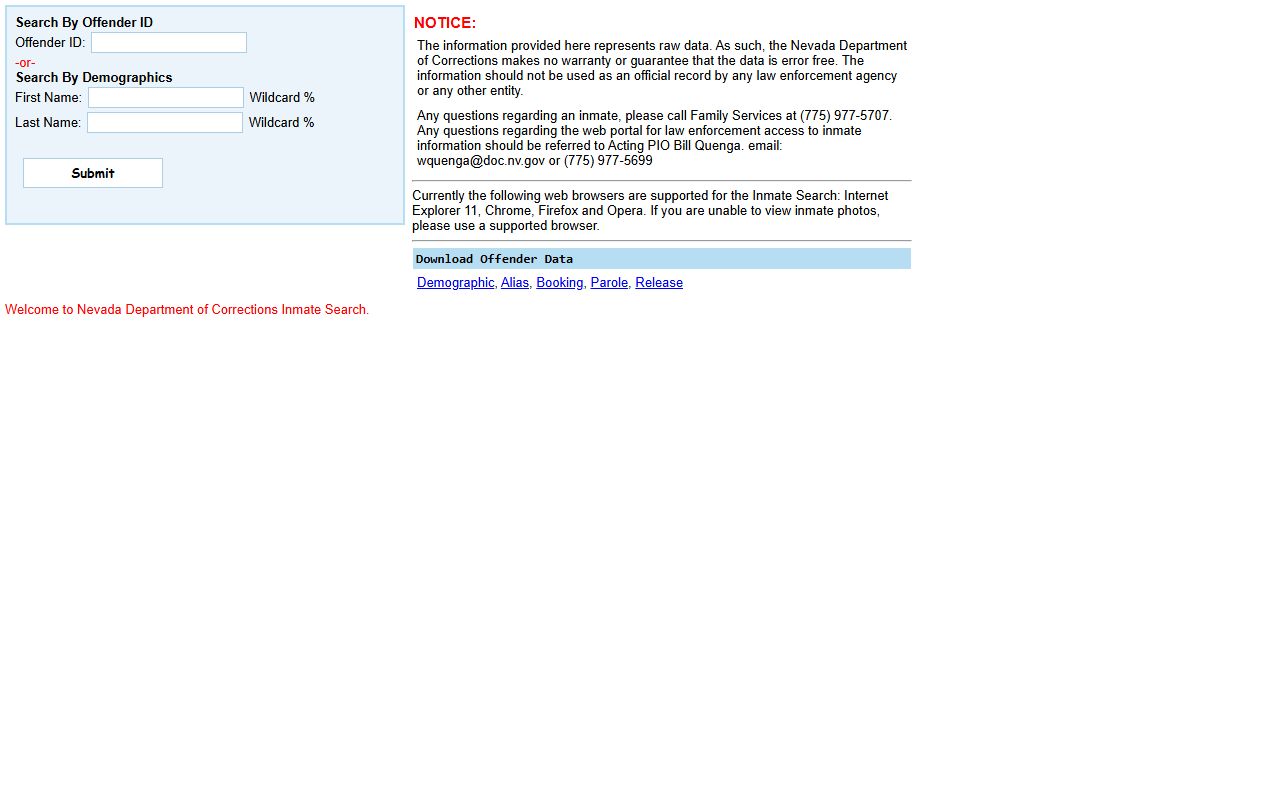
The locator is the best public starting point for sentenced Nevada prisoners, but it should not be treated as the only custody check.
What an NDOC Record Shows
NDOC's search and data exports are organized around different data categories. The research identifies Demographic, Alias, Booking, Parole, and Release files available from the search page. That structure matters because a current custody question, a sentence history question, an alias question, a parole event question, and a release question may not be answered by one field on one screen. NDOC also warns that search information is raw data and is not guaranteed error free.
| Field or Data Group | What It Helps Confirm |
|---|---|
| Offender ID | The most precise NDOC search identifier for a state-prison record |
| Demographic data | Name and identity details published through NDOC data categories |
| Alias data | Alternate names that may explain a failed exact-name search |
| Booking data | Prison admission or custody data in NDOC records, separate from county jail booking |
| Parole data | Parole-related events or eligibility material where reflected in NDOC data |
| Release data | Release-related data categories, subject to NDOC limits and update timing |
Important: An NDOC no-result does not prove no custody; the person may be in jail, federal custody, ICE custody, or listed under another spelling.
NDOC Prisons and Facilities
NDOC operates a varied state-prison network rather than one generic prison. The research identifies High Desert State Prison, Southern Desert Correctional Center, Florence McClure Women's Correctional Center, Casa Grande Transitional Housing, Northern Nevada Correctional Center, Stewart Conservation Camp, Lovelock Correctional Center, Ely State Prison, Carlin Conservation Camp, Humboldt Conservation Camp, and Pioche Conservation Camp as active or directory-relevant NDOC operations. County research also identifies shuttered or historical facilities, but closed locations are not current inmate-search destinations.
The official NDOC facilities page lists state prisons, conservation camps, and related facility links.
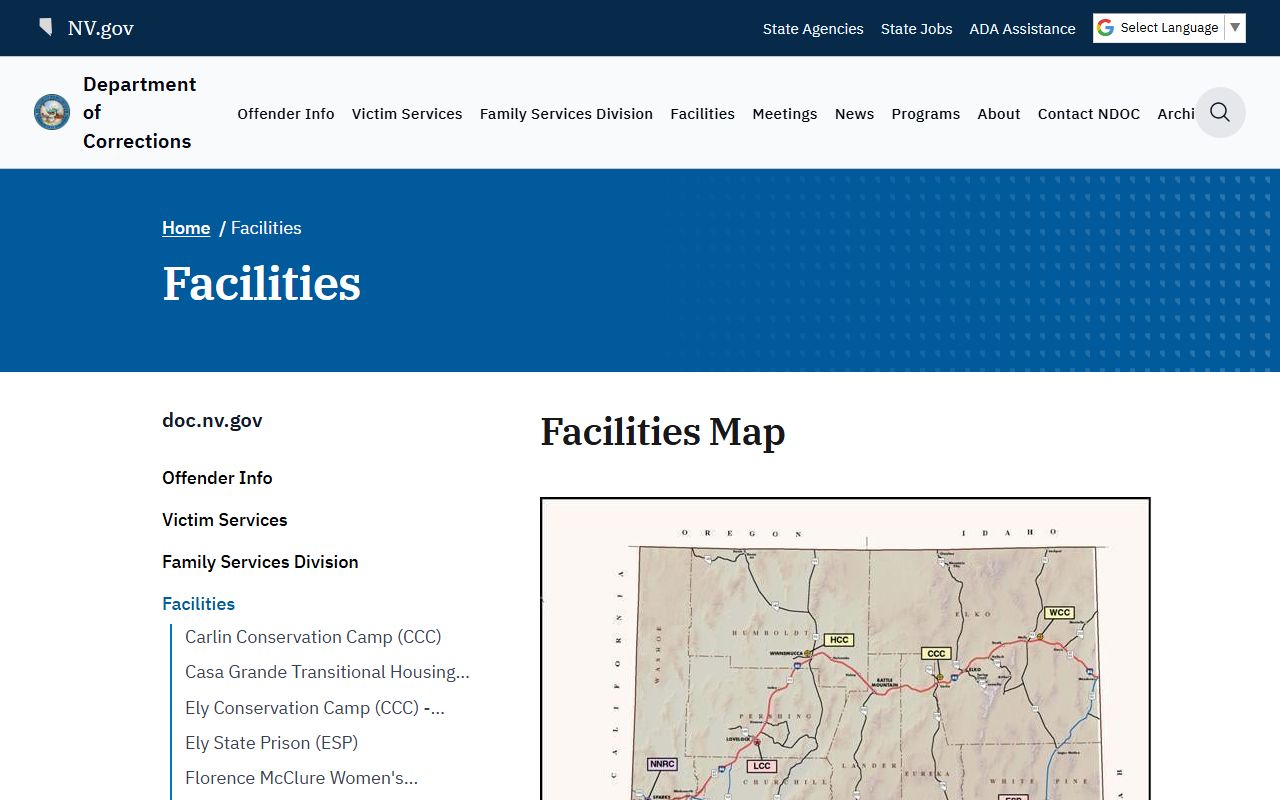
The statewide facility directory adds local jails and federal or ICE-linked facilities beside NDOC rows, so the facility type should always drive the search method.
| Facility Type | Examples from Nevada Research | Search Method |
|---|---|---|
| Major prison | High Desert, Southern Desert, Ely, Lovelock, Northern Nevada | NDOC offender search |
| Women's correctional center | Florence McClure Women's Correctional Center | NDOC offender search |
| Conservation camp | Carlin, Humboldt, Pioche, Stewart | NDOC offender search |
| Transitional housing | Casa Grande Transitional Housing | NDOC records and facility routing |
NDOC Sentencing and Parole
Nevada sentencing and release cannot be reduced to one simple release-date rule. NRS 176.033 distinguishes definite misdemeanor or gross misdemeanor terms from felony sentencing, where courts often impose minimum and maximum terms unless a statute requires a definite sentence. NRS 176.035 covers concurrent and consecutive sentences, and NRS 176.055 addresses credit for time spent in confinement before conviction, subject to exceptions.
NDOC manages sentence timekeeping. The Nevada Board of Parole Commissioners says it does not decide who is eligible for parole and does not calculate sentence expiration dates. NDOC records statutory credits and sentence-management data, while the Board decides parole matters. The Board's page describes parole as discretionary, states that parole hearings for eligible inmates are generally held about three months before minimum eligibility dates, and says notifications are made after the vote is ratified. Nevada Parole and Probation's Pre-Release Unit adds a practical point: no inmate may be released on parole until verified placement is approved.
- Minimum term
- The part of a Nevada felony sentence tied to parole eligibility, subject to statute and credits.
- Maximum term
- The outside sentence limit unless release, parole, credit, revocation, or another lawful event changes custody status.
- Parole eligibility
- A date or status allowing parole consideration, not a guarantee of release.
- Verified placement
- A required approved release plan for parole release, as described by Nevada Parole and Probation.
NDOC Records Requests
NDOC separates offender information requests and public-record requests. Offender information requests go to omdrecords@doc.nv.gov or to ATTN: Offender Management Division, Nevada Department of Corrections, P.O. Box 7011, Carson City, Nevada 89702. Public records requests use publicrecords@doc.nv.gov and the Public Information Office. NDOC's public-record fees page cites NRS Chapter 239 and the five-business-day inspection response used in Nevada public-record law.
The NDOC records and information page provides the offender-record route for requests beyond the public search result.
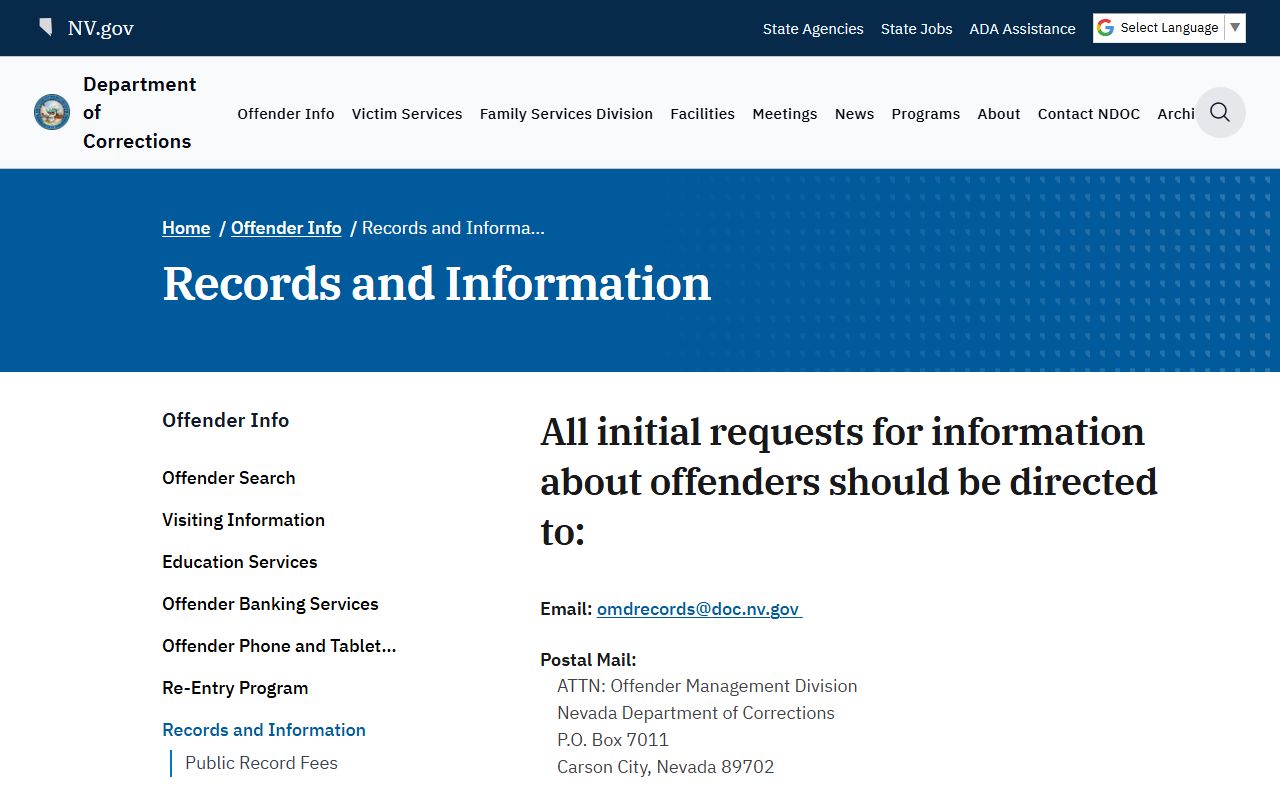
Formal records requests are the better path for records that need agency handling, context, redaction, or official custody from the record holder.
The NDOC public-record fees page explains the Public Information Office route and links the process to Nevada public-record law.
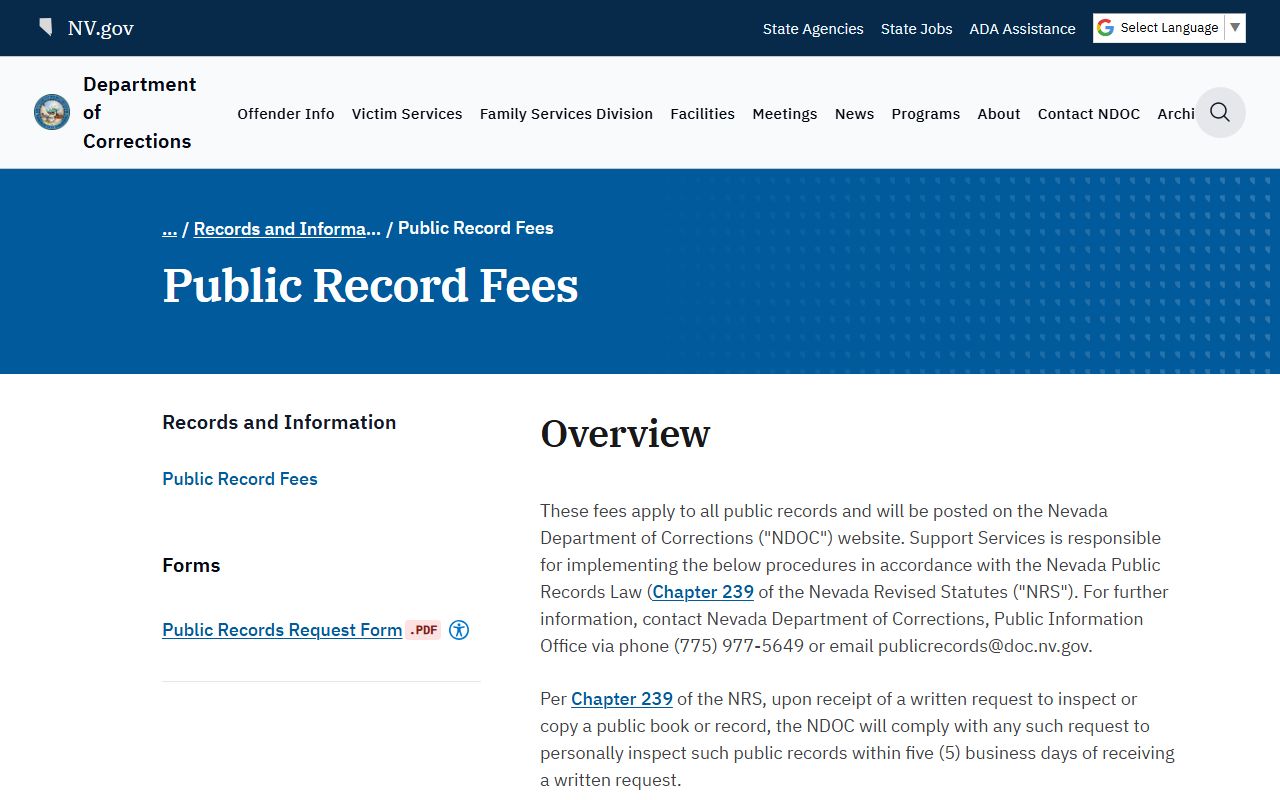
Requests should be narrow enough for the custodian to identify the record, especially when names, offender IDs, dates, and facility history are known.
NDOC vs. County Jail
The NDOC inmate population is not the same as the Nevada jail population. County jails and city detention centers handle arrest booking, court holds, pretrial custody, misdemeanor sentences, and local short sentences. NDOC handles sentenced state-prison custody. Federal prisoners use BOP or U.S. Marshals channels. Immigration detention uses ICE ODLS. Notification tools such as Nevada S.A.V.E. and VINELink help with alerts, but they do not replace the custody system that created the record.
| Question | Best Starting Point | Why |
|---|---|---|
| Serving a Nevada state-prison sentence? | NDOC offender search | NDOC runs the state prison system |
| Booked after a recent arrest? | County or city jail roster | Local agencies handle booking and pretrial custody |
| Sentenced in federal court? | BOP inmate locator | BOP tracks federal sentenced prisoners |
| Possible immigration detention? | ICE ODLS | ICE custody is a federal immigration system |
NDOC Inmate Population FAQ
How big is the NDOC inmate population?
NDOC reported 10,587 in-house offenders on December 31, 2025. That is the state-prison in-house count from the monthly distribution, not a count of every jail or federal detention bed in Nevada.
How is the NDOC inmate locator searched?
The locator can be searched by Offender ID or by first and last name. The percent wildcard can help when spelling is uncertain.
Why does a recent arrestee not appear in NDOC?
A recent arrestee usually starts in county or city jail. NDOC is the state-prison layer after commitment, so local jail and court records may be the better starting point.
Public Record Search
Sponsored Results